The founder of chiropractic, Daniel David (D. D.) Palmer, was born on March 7, 1845, in Pickering, Ontario, Canada. He grew up in an era when many alternative treatment methods were practiced, such as homeopathy, hydrotherapy, and magnetic healing. In his youth, Palmer worked as a teacher, farmer, and beekeeper, but he developed an early interest in health and healing. During the 1880s, he established himself in Davenport, Iowa, as a magnetic healer, a practice based on the belief that illness could be influenced by the body's magnetic fields. It was here that he began to develop his ideas about the importance of the spine for human health.
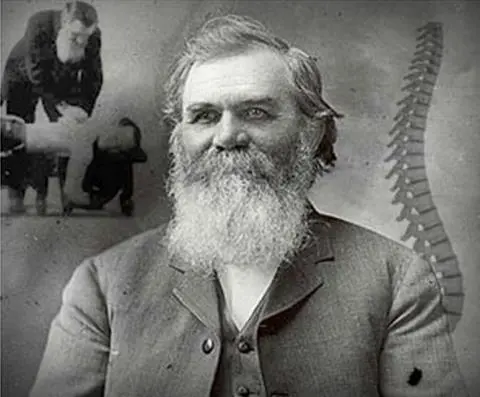
The event often considered the starting point for chiropractic took place on September 18, 1895. A janitor named Harvey Lillard, who had suffered from hearing loss for many years, visited Palmer. During the examination, Palmer felt a change in Lillard's spine. He performed a manual adjustment of a vertebra – and according to the story, Lillard regained some of his hearing shortly thereafter.
Palmer saw this as proof of a connection between the spine and the function of the nervous system, and he began to develop a theory that many illnesses could be caused by so-called "subluxations" – misalignments in the spine that disrupted nerve flow.
Two years after the first adjustment, Palmer opened a school in Davenport – the Palmer School of Chiropractic – to train others in the new treatment method. The name "chiropractic" was chosen from a combination of the Greek words "cheir" (hand) and "praktikos" (to do), meaning "done by hand." The first programs were short, often only a few months long, and consisted largely of practical demonstrations. However, the school soon grew, and the first generations of chiropractors began to spread the profession further across the U.S.
Chiropractic grew rapidly but also faced strong opposition. The established medical community viewed chiropractors as competitors, and many were prosecuted for practicing medicine without a license. D. D. Palmer himself was sentenced to prison in 1906. At the same time, his son, Bartlett Joshua (B. J.) Palmer, became a central figure. He took over leadership of the school and developed both the curriculum and the profession's identity. B. J. introduced more systematic studies in anatomy and physiology, and he was also one of the first in the healthcare field to use X-rays for diagnostic purposes (1910).
Despite the opposition, the number of chiropractors grew steadily, and several schools were started across the U.S. Patient support was crucial for the profession's survival and establishment. During this period, chiropractic also began to spread internationally. Practitioners traveled to Canada, Australia, New Zealand, and parts of Europe. Organizations were formed to unite and strengthen the profession, and demands for longer educational programs increased.
The 1960s marked a new era for chiropractic. An increasing number of research studies on the treatment of back pain were published, and the results helped strengthen the legitimacy of the profession. At the same time, the profession fought for recognition in courts and through legislation.
In 1974, chiropractic was officially recognized in all U.S. states, and state-accredited educational programs were established. During this period, a more scientific and critical discussion regarding the theory of subluxation also began, with many chiropractors moving toward a more evidence-based understanding of treatment effects.
Chiropractic was established in the Nordic region in the 1980s, starting in Denmark, where the profession gained a clear role within the healthcare system. In Norway and Sweden, licensure for chiropractors was introduced later, which strengthened the profession's position and increased collaboration with other healthcare sectors. At the same time, research expanded, and international partnerships were formed to strengthen the academic foundation of chiropractic. Universities and colleges in countries such as the UK, Australia, and Canada began offering research-linked degree programs.
Today, chiropractic is an established part of healthcare in many countries. The focus is on evidence-based care, interdisciplinary collaboration, and long-term patient benefits. Chiropractors contribute by treating both acute and chronic pain conditions, as well as providing preventive care for better health. The development of chiropractic reflects a journey from one practitioner's idea in Davenport to a global healthcare discipline with university-level education, professional licensure, and a strong research foundation. The profession continues to evolve, and future chiropractors are trained to meet new societal needs – always with the patient's health and quality of life as the primary goal.