NIMM stands for the Nordic Institute for Manual Medicine. It brings together the Naprapathic College, the Chiropractic Academy, and the Osteopathic College in a shared educational environment for manual medicine.
We train the naprapaths, chiropractors, and osteopaths of the future with a focus on clinical competence, practical skills, science, and professional responsibility in patient care.
Today, NIMM is the Nordic region's largest higher education institution for manual medicine and the only one in the world that brings together naprapathy, chiropractic, and osteopathy in a unified educational environment.
At NIMM, you can study the naprapathy program, the chiropractic program, or the osteopathy program. All three are four-year, full-time programs in manual medicine.
For the first three years, the programs share a common foundation in anatomy, physiology, medical subjects, pain, diagnostics, manual therapy, rehabilitation, scientific methodology, professional development, and clinical training. The fourth year is profession-specific and provides specialization in naprapathy, chiropractic, or osteopathy.
All three programs are four years full-time.
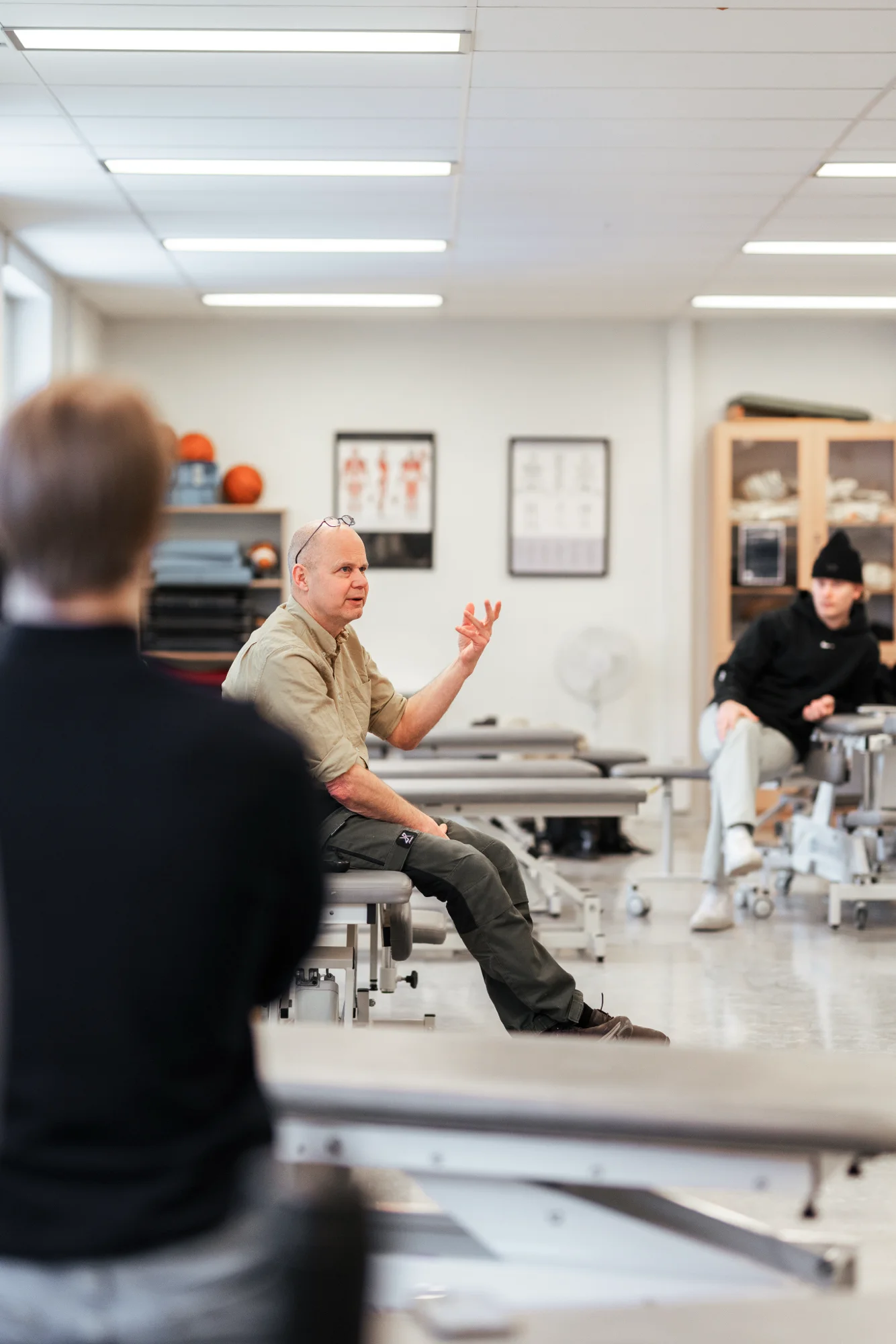
Theoretical and practical instruction is primarily conducted at NIMM's facilities in Kräftriket, Stockholm—a scenic and inspiring environment close to both the city pulse and green spaces.
Clinical training takes place at the NIMM Clinic at Odenplan in central Stockholm, as well as through external clinical placements.
Campus Albano is located right next to Kräftriket, placing NIMM in the heart of Stockholm's academic hub, complete with student housing, restaurants, and a vibrant campus life.
No. The programs are primarily held on-site in Stockholm. While there are some digital components, the programs are based on physical attendance, practical skills training, and clinical work with patients.
Yes, many students work part-time alongside their studies. However, our programs are full-time and require attendance, independent study, and practical training.
Manual medicine is a field focused on the examination, diagnosis, treatment, and rehabilitation of issues involving muscles, joints, nerves, and the musculoskeletal system. Treatment is often performed manually—for example, through mobilization, manipulation, soft tissue therapy, rehabilitative exercises, and guidance.
A naprapath examines, diagnoses, treats, and prevents problems in muscles and joints. Naprapaths often work with the back, neck, shoulders, hips, knees, sports injuries, and strain-related issues.
Treatment may include mobilization, manipulation, trigger point therapy, soft tissue therapy, stretching, rehabilitative exercises, and counseling. The goal is to reduce pain, improve function, and help the patient return to daily life, work, or sports. Read more about what a naprapath does under the heading about naprapathy
A chiropractor works with the examination, diagnosis, treatment, and prevention of musculoskeletal disorders, often with a special focus on the spine and the body's joints. During the chiropractic program, students delve into areas such as diagnostic imaging and laboratory tests.
Chiropractors use manual techniques such as joint adjustment, mobilization, soft tissue therapy, and rehabilitation. Modern chiropractic is based on clinical reasoning, patient safety, evidence-based methods, and a person-centered approach. Read more about what a chiropractor does under the chiropractic section
An osteopath works with manual medicine, focusing on the whole person and the interplay between the body's structure, function, and movement. Osteopaths primarily assess and treat issues related to the musculoskeletal system, combining manual techniques with health advice and support for self-care. The program also emphasizes the relationship between different body systems, clinical reasoning, and person-centered care.
At NIMM, osteopathy is developed as a modern, evidence-informed program where the historical roots of osteopathy are combined with current knowledge in musculoskeletal health, pain, clinical methodology, and patient safety. Read more about what an osteopath does under the section about osteopathy
There are several groups of therapists who work with manual medicine, such as naprapaths, chiropractors, and osteopaths. These professions share a common origin, having emerged in the USA during the late 19th and early 20th centuries.
There are both differences and similarities between these professions, and you can contact the respective professional associations to learn more.
Swedish Naprapathic Association
Swedish Chiropractic Association
Chiropractic Association
Swedish Osteopathic Association
While all three focus on health, function, and rehabilitation, the emphasis of each program differs.
Manual medicine encompasses three professions: naprapathy, chiropractic, and osteopathy. They all involve four-year programs at NIMM, where manual medicine is a core component throughout the entire curriculum. Students are trained early and continuously in examination, diagnostics, manual treatment, clinical reasoning, and patient interaction.
Physiotherapists are trained through a three-year university program and work broadly with function, exercise, rehabilitation, disease-related conditions, and returning to activity. Most physiotherapists work within the public healthcare system, while the majority of manual therapists work in privately funded healthcare. Some physiotherapists pursue further education in Orthopedic Manual Therapy (OMT) and then work more explicitly with manual methods.
One is not better than the other. They are different professions with different educational paths, traditions, and roles in healthcare.
Choose NIMM if you want a four-year education where manual medicine, practical skills training, and clinical patient work are at the core from day one.
The physiotherapy program is a vital and broad healthcare degree. NIMM’s programs are more specialized, focusing on manual medicine, musculoskeletal health, pain, function, manual therapy, clinical examination, and independent professional practice within private, insurance-funded, and patient-centered care.
Yes. Naprapaths and chiropractors are licensed professions in Sweden. After completing an approved education, you must complete a period of practical service in accordance with current regulations before you can apply for a license from the National Board of Health and Welfare.
No, not at the moment. Unlike in other Nordic countries, osteopath is not yet a licensed professional title in Sweden.
However, the issue is current. In SOU 2025:63, it is assessed that osteopaths meet several of the criteria for professional registration, but that Swedish university-level education with a scientific foundation has been lacking as a basis for regulation. NIMM's osteopathy program is developed to meet that very need.
The Naprapath and Chiropractor programs are eligible for CSN funding. This means that Swedish students can apply for student grants and additional loans to cover tuition fees.
The osteopathy program is currently not eligible for CSN student aid. NIMM is working to ensure that the osteopathy program will also be covered by student funding.
Yes, Norwegian students can generally apply through Lånekassen and Finnish students through Kela, depending on the current terms and conditions of the respective authorities. Students should always check the latest information with their student aid agency.
The cost of the program can be found under the heading Student finance and fees.
For the naprapathy and chiropractic programs, Swedish students can apply for an additional loan to cover tuition fees. For 2026, the additional loan is stated to cover the full tuition fee for the program. Read more under the heading Student finance and fees.
The osteopathy program is currently not eligible for CSN funding.
There are no scholarships or funds directly linked to the NIMM program. However, there are external scholarship databases where students can apply for support themselves.
For applicants with grades from Sweden, general eligibility for higher education applies.
For applicants with grades from Norway, general study competence applies.
For applicants with grades from other countries, an individual assessment is made, and foreign grades may need to be evaluated by the Swedish Council for Higher Education. Swedish as a second language 1–3 and English are required.
Read more about merit points under the heading Eligibility & selection.
No, not as a general requirement. You need basic eligibility. However, the programs include a lot of anatomy, physiology, medicine, pain science, and clinical reasoning, so an interest in the body, health, and natural sciences is a clear advantage.
A high merit rating is not a deciding factor when applying to our programs. We fill study places on a rolling basis for those who meet the basic eligibility requirements, which means that admitted students from Sweden typically have between 13 and 21 points, including merit points.
For applicants with grades from Norway, those admitted usually have between approximately 3.0 and 5.9 points, including merit points.
Read more under the heading Eligibility & Selection.
NIMM uses its own system for merit points. This means that certain academic and professional experiences can earn you extra points that are added to your grade point average.
Relevant qualifications may include specific upper secondary school subjects, university studies, internships with a naprapath, chiropractor, or osteopath, as well as personal trainer or massage therapy certifications.
Read more about merit points under the heading Eligibility & Selection.
Applying early can increase your chances of securing a spot, as we fill places on a rolling basis. This assumes that you meet the eligibility requirements.
You can read more under the heading Eligibility & Selection.
Applications for the programs are now open. Admissions are processed on a rolling basis, and applications will close once all spots are filled. Read more under the heading Application.
The autumn semester 2026 begins on August 24. Read more under the heading Application.
NIMM has 120 study places per academic year (480 study places in total) distributed across the naprapathy, chiropractic, and osteopathy programs.
The number of students varies from year to year, typically ranging between 200 and 400 in total. NIMM’s educational environment welcomes students from Sweden, Norway, and Finland, and is characterized by close collaboration between students, teachers, supervisors, and clinical practice.
Yes, you can either join the NIMM-student Facebook group, or why not sign up to be a student for a day? Read more and sign up under the heading Student for a day.
You can also contact the student union; read more under the heading Student Union.
Yes. You can contact NIMM's education coordinator for questions regarding eligibility, selection, funding, course content, student life, and careers. Book an appointment under the heading Study Guidance.
Yes. If you have previously studied physiotherapy, medicine, nursing, or another relevant program, you can apply for an individual assessment for credit transfer. Read more under the heading Eligibility and selection.
This may be possible, but is assessed on an individual basis. NIMM needs to review previous studies, course content, level, scope, and relevance in relation to NIMM's curriculum. Read more under the heading Eligibility and selection.
The programs combine theory, practical skills training, and clinical instruction. You will study medical subjects such as anatomy, physiology, neurology, orthopedics, pathology, pain management, and clinical diagnostics, while simultaneously practicing manual examination, treatment, rehabilitation, communication, and professional conduct.
This means that students in the naprapathy, chiropractic, and osteopathy programs share a common foundation in manual medicine during the first three years. This provides a broad understanding of the entire field and fosters interprofessional collaboration from an early stage.
In year 4, you will specialize in your chosen profession: naprapathy, chiropractic, or osteopathy.
The fourth year is profession-specific and is at an equivalent advanced level. Here, you will deepen your knowledge, skills, and clinical reasoning within your chosen field: naprapathy, chiropractic, or osteopathy.
Yes. Clinical instruction, VIL, and VFU are central components of the programs. You will gradually encounter patients, practice clinical reasoning, and develop practical skills under supervision. VIL/VFU primarily takes place at NIMM Klinik.
Clinical practice at the student clinic in Odenplan begins as early as the second semester under the supervision of licensed manual therapists.
Yes, under supervision. Students treat patients as part of their clinical training and under the responsibility of supervisors with relevant professional qualifications.
Regardless of which program you choose, you will study subjects including anatomy, physiology, neurology, orthopedics, pathology, pain management, pharmacology, diagnostic imaging, rehabilitation, exercise science, sports medicine, scientific methodology, professional development, and program-specific manual medicine.
Yes. Scientific development is integrated throughout the program. You will conduct a major literature review during your third year and write a thesis as part of the program in your fourth year. The goal is to develop your ability to search for, evaluate, and apply scientific knowledge in clinical practice.
Absolutely. NIMM's programs are practically oriented courses where theoretical knowledge is constantly linked to clinical situations, manual skills training, and patient-centered instruction.
The language of instruction is Swedish. Lectures in English may occur, and course literature may be in both Swedish and English.
After the first year, students who have passed the relevant modules may have the opportunity to pursue external certification as a massage therapist and personal trainer.
The massage therapist certification is based on fundamental theoretical and practical knowledge of anatomy, physiology, classical massage, treatment methodology, hygiene, client interaction, and safe professional practice. The certification demonstrates that you have an industry-relevant foundation for working with wellness massage.
For personal trainers, this refers to the opportunity for a PT license at EQF level 4. It is based on knowledge of anatomy, physiology, exercise science, testing, program design, instruction, and individualized training. Active Sweden's national PT license, formerly the FRISK license, serves as an industry standard and a mark of quality for personal trainers in Sweden.
Certification and licensing are subject to the requirements and terms set by each respective external certification or licensing organization.
Yes. NIMM offers a program adapted for elite athletes (HEP - Higher Education with Elite Sports Program) for students competing at an elite level. The adjustments are assessed on an individual basis and require certification from a national sports federation.
Student life at NIMM is something truly special. As a smaller, specialized college, you get a close-knit community where students, teachers, and clinical practice truly come together. Here, you quickly become part of the community, both in the classroom and outside of your studies.
Stockholm is also a fantastic city to study in, with a vibrant student life, wonderful surroundings, and plenty of activities all around the city.
A large part of the community is built through the NIMM Student Union, which organizes everything from formal dinners and parties to sports activities and other fun events throughout the year. There is always something to get involved in and plenty of opportunities to meet new people. Read more about the Student Union's work under the heading Student Union.
The smaller school environment gives your time at NIMM a unique, personal feel, full of community. Join the NIMM-student Facebook group, where you'll find tips, recommendations, event information, buy & sell posts, and job offers. The group is also a great forum for those looking for housing, have rooms to rent out, or simply want to connect with prospective students.
Many students find housing through student accommodation, while others sublet, rent a room, or even choose to buy a home. Our best tip is to start looking well in advance.
Information about student housing is available through the Stockholm Federation of Student Unions (SSCO).
Student housing in Stockholm is managed by the Stockholm Student Housing Foundation (SSSB).
You can find more information about housing in Stockholm at Jagvillhabostad.nu. In addition to practical tips and advice, you will find contact details and links to a variety of housing market stakeholders. The site Hyresvardslistan.se provides a comprehensive list of landlords in Stockholm and other areas. Homii.se is another free service.
The job market for manual medicine professions is broad. Naprapaths, chiropractors, and osteopaths often work in private healthcare, wellness, occupational health, sports, rehabilitation, and private practice.
Demand is driven by factors such as increased pain issues, a growing interest in physical activity, work-related ailments, sports injuries, and the need for rehabilitation.
Yes, many professionals in manual medicine run their own clinics or work as consultants. While the training provides a clinical foundation, running a business also requires commercial awareness, accountability, patient insurance, medical record-keeping procedures, and knowledge of relevant laws and regulations.
Income varies significantly and depends more on your practice model, experience, patient base, geographic location, and business establishment than on whether you are a naprapath, chiropractor, or osteopath. Currently, there is limited reliable salary data for these individual professions, and the available information does not support any clear conclusions regarding systematic salary differences between these occupational groups.
Many work in the private sector, either as clinic employees or by running their own practice. As a self-employed practitioner, your income is influenced by patient volume, pricing, overhead costs, and how well-established your business is. As an employee, your salary is affected by your experience, employer, performance, and level of responsibility.
Early in your career, and especially during internships required for licensure, compensation is typically lower. Over the long term, income can grow through experience, specialization, consistent patient flow, and your choice of practice model.
After four years of successful studies, you will receive your naprapathic degree. You then complete your practical service in accordance with current regulations and can subsequently apply for professional licensure from the National Board of Health and Welfare in Sweden or the Norwegian Directorate of Health.
Read more under the heading Naprapathic degree and career.
After four years of approved studies, you will receive a degree in chiropractic. You then complete a period of practical service in accordance with current regulations, after which you can apply for professional registration with the National Board of Health and Welfare in Sweden or the Norwegian Directorate of Health.
Read more under the heading Chiropractic degree and career.
After four years of approved studies, you will receive an osteopathy degree from NIMM. Osteopath is currently not a licensed profession in Sweden, but NIMM is working to contribute to a Swedish educational foundation that can support future regulation of the profession.
The osteopathy profession is regulated in all Nordic countries except Sweden. Contact your local authorities to find out what applies.
Read more under the heading Osteopathy degree and career.
For naprapaths and chiropractors, NIMM's programs may serve as a basis for authorization in Norway, in accordance with the regulations of the Norwegian authorities. Always check the latest information with the Norwegian Directorate of Health.
Special rules apply to osteopaths, as the profession is regulated in several Nordic countries but not yet in Sweden. Students should check the current requirements in the country where they intend to work.
Licensed naprapaths and chiropractors are covered by a common Nordic labor market for certain healthcare professionals. The agreement means that individuals with a healthcare license automatically have their credentials recognized, allowing them to practice their profession in other Nordic countries where the profession is regulated. This does not apply in Europe or the rest of the world, making it important to check the specific laws and regulations you must follow to work in the country in question.
Yes, NIMM's naprapathic and chiropractic programs are under state supervision, with the Swedish Higher Education Authority (UKÄ) serving as the regulatory body. Furthermore, NIMM maintains quality assurance, educational plans, syllabi, and examinations structured to university standards.
NIMM issues its own professional diplomas: Naprapathic Diploma, Chiropractic Diploma, and Osteopathic Diploma. NIMM's long-term goal is for these programs to eventually lead to an academic degree through validation from a foreign higher education institution or via degree-awarding powers within the Swedish higher education system.
Yes. NIMM is a private educational institution. The programs are fee-based and primarily funded through tuition fees. At the same time, NIMM operates with quality standards, syllabi, curricula, and examinations based on higher education principles.
DN stands for Doctor of Naprapathy and is a historical class designation at the Scandinavian College of Naprapathic Manual Medicine. Class codes are used for administrative purposes and do not affect the curriculum, degree, or the professional licensing process. The corresponding designations DC and DO are used for chiropractors and osteopaths, respectively.
Choose the naprapathy program if you want a clear focus on muscles, joints, sports medicine, manual therapy, and rehabilitation with a strong practical breadth.
Choose the chiropractic program if you are drawn to the spine, joints, neurology, biomechanics, diagnostics, and evidence-based chiropractic care.
Choose the osteopathy program if you want to work with manual medicine from an integrative perspective on structure, function, holism, and person-centered care.
Unsure? Contact us for study guidance at linda.ladenstedt@nimm.se


By clicking "Accept all cookies", you agree to the storing of cookies on your device to enhance site navigation, analyze site usage, and assist in our marketing efforts.