Osteopathy is a profession within manual medicine that focuses on the examination, assessment and treatment of problems affecting the body’s muscles and joints. Manual techniques are combined with advice, movement and rehabilitation based on the person’s problems and circumstances. If you are drawn to a hands-on profession with close patient contact, it offers a way to combine knowledge of the body with practical treatment work.
Physiotherapy has a broader scope covering movement, function and health. As a physiotherapist, you might work with rehabilitation after injuries and surgery, neurological conditions or heart and lung disease. Physiotherapists also examine and treat problems in muscles and joints, and manual treatment can be part of the work. There is also the option of further training in orthopaedic manual therapy (OMT).
The professions therefore have points in common. If you are choosing a programme, an important question is what focus you want to build your professional expertise around.
Programme in Sweden
Four years full-time at NIMM, with manual medicine at its core and a fourth year of in-depth osteopathic study
Emphasis
Examination, assessment and treatment of problems affecting muscles and joints, with a person-centred, holistic perspective
Licensure in Sweden
Osteopathy is not currently a licensed profession in Sweden
In Norway
A licensed profession since 2022. The Norwegian Directorate of Health (Helsedirektoratet) assesses education and professional experience
Programme in Sweden
Three years full-time, 180 credits
Emphasis
Movement, function and rehabilitation for many patient groups and conditions
Licensure in Sweden
After completing the degree in physiotherapy
In Norway
Three-year bachelor’s degree and one year of internship (turnus) before licensure
The breadth of physiotherapy
Where the professions meet
The focus of osteopathy
The diagram shows where each programme places its emphasis, not the limits of what an individual practitioner works with.
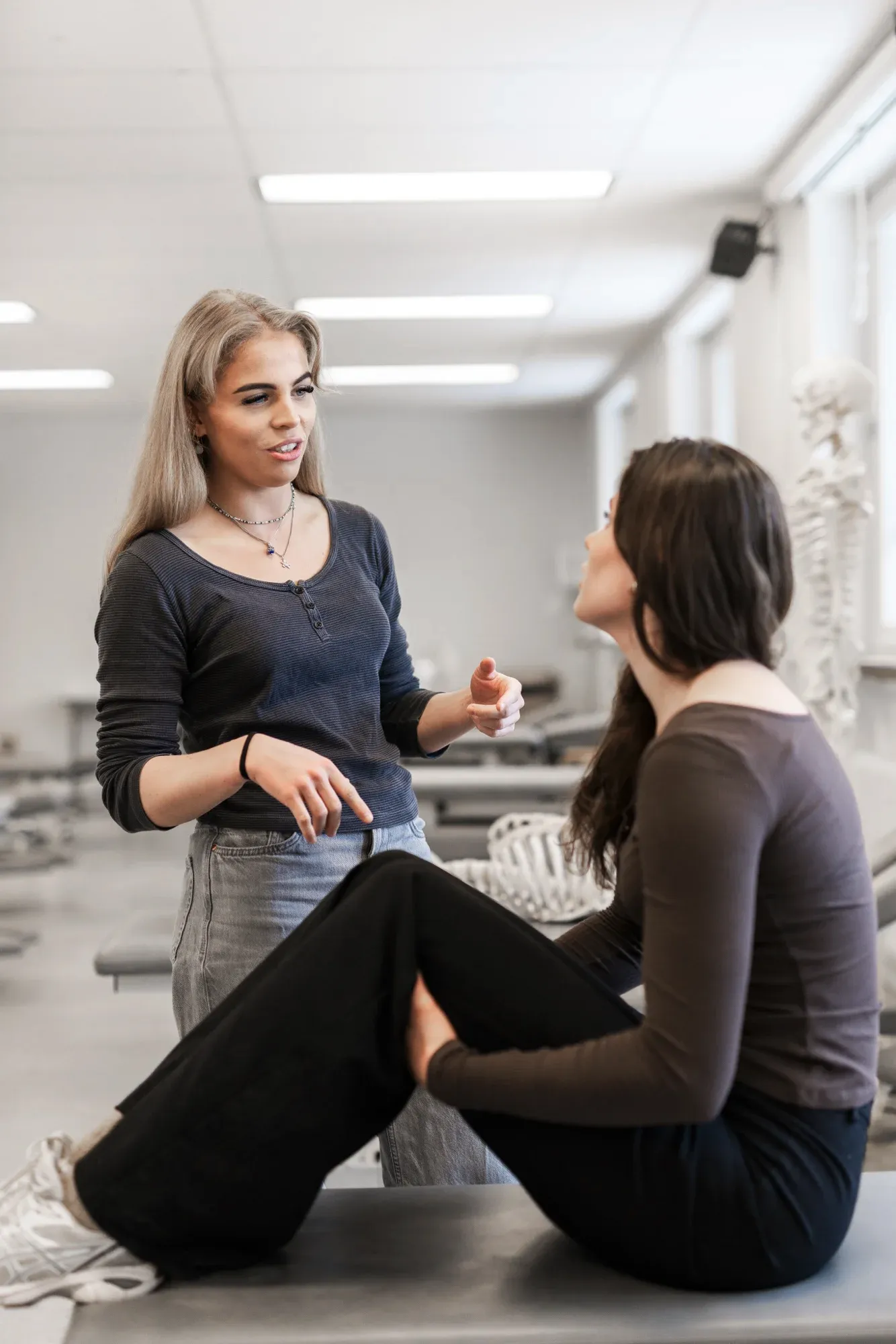
Imagine someone seeking help because her shoulder hurts when she exercises, gets dressed or lifts something at work. As an osteopath, you start by listening. When did the problem start? What works well and what has become difficult? What does the person want to be able to do again?
Then you examine. You observe movements, test function and use your hands to assess things such as mobility and tenderness. You weigh what the person tells you against your examination findings and assess what may be contributing to the problem. An important part of the work is also deciding when the person needs to be assessed elsewhere in the healthcare system.
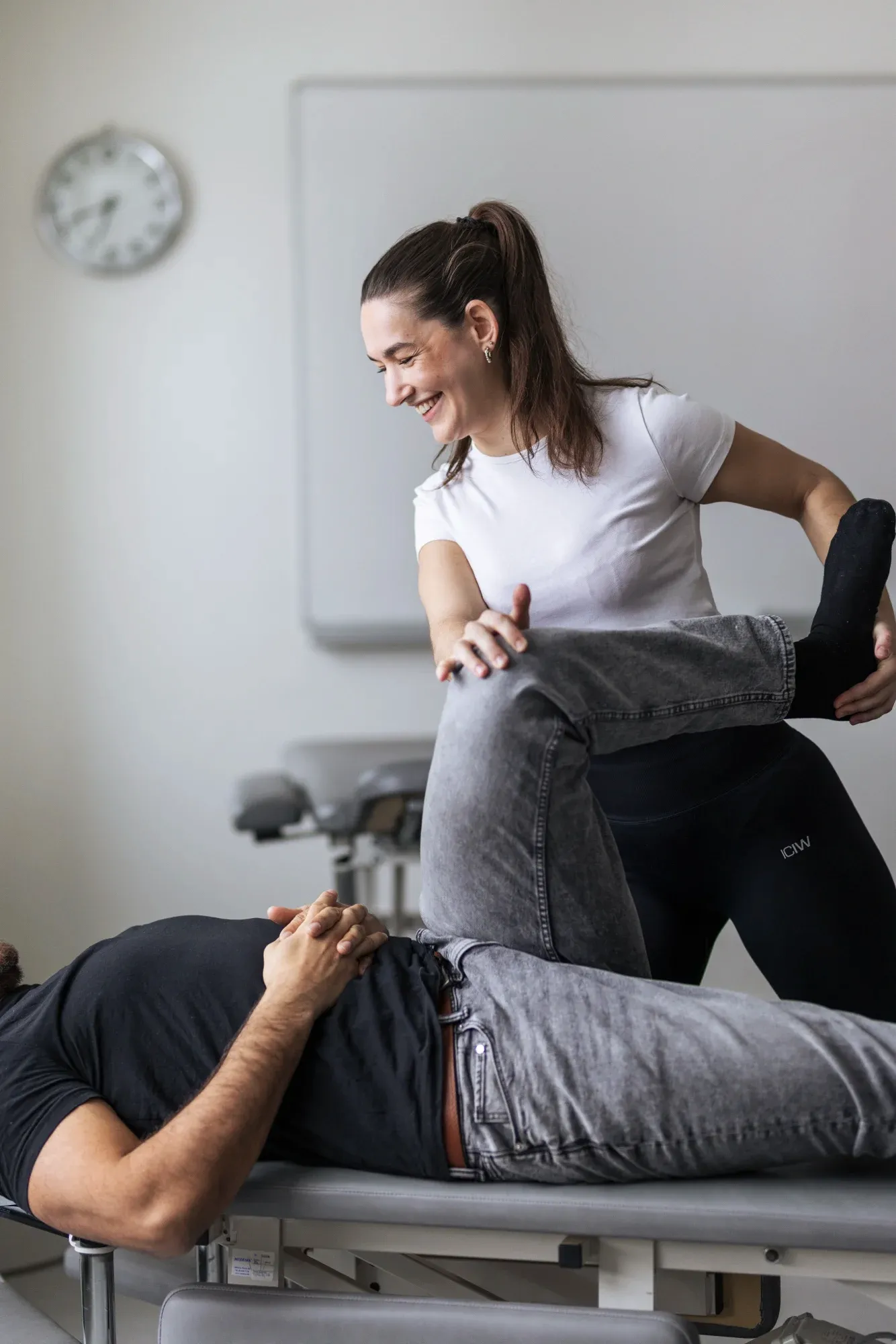
Treatment may include manual techniques for muscles and joints, together with exercises and advice on load and activity. You explain your assessment, agree on a plan with the person and follow up on how things are going. It is the interplay between the conversation, the examination, the treatment and the patient’s own efforts that makes the work both practical and analytical.
If you are curious about the human body, there is a lot to discover. How do you assess a movement that hurts? Which questions help you understand the problem better? How do you adapt treatment when two people have similar symptoms but completely different everyday lives?
These are the kinds of questions you will learn to work with.
At the School of Osteopathy at NIMM, you study full-time for four years in Stockholm. You train in an environment where manual medicine is at the centre and where naprapathy, chiropractic and osteopathy meet. The programmes share a medical and clinical foundation, while you develop your competence towards the osteopathic profession.
If you already feel that this kind of patient work is what you want to devote yourself to, the added value lies in the programme’s overall focus: combining knowledge, practical skill and the ability to make well-considered decisions, step by step.
Anatomy and physiology help you understand how the body is built and how it works. In practical teaching, you put that knowledge to use in examination and treatment. Among other things, you train palpation – examining with your hands – movement analysis, joint mobilisation and soft tissue techniques. Your skills develop alongside your ability to interpret findings and judge what is relevant for the patient.
Reading about an examination and being able to carry it out yourself are different stages of learning. When you practise, you need feedback on how you are doing, a chance to explain what you perceive and the opportunity to test how the information affects your assessment.
Clinic-based teaching with patient encounters under controlled conditions starts as early as the first year. Later, your patient work develops through supervised practice. At NIMM Clinic, you apply what you learn when meeting people who come for help.
Meeting a patient makes different demands from practising with a fellow student. You need to build trust, ask questions people understand and adapt your reasoning to the person in front of you. That is where knowledge gains context and your professional role starts to take shape.
After a shared foundation in manual medicine during the first three years comes a profession-specific fourth year. For osteopathy students, this means in-depth study of osteopathy and continued development of clinical judgement. The programme leads to NIMM’s own osteopathy degree.
If you are comparing programmes, it is worth finding out what the years of study involve: which skills you get to practise, how supervision works and how well the programme’s focus matches the work you want to do.
Osteopathy emphasises the connection between the body’s structure, its function and the person’s life situation. This means, for example, that an assessment of back problems may need to take account of physical load, sleep, recovery and how the person experiences and manages their pain.
This person-centred approach means that examination and treatment are adapted to the individual. Two people with pain in the same place do not necessarily have the same needs or the same goals. For one, the priority is being able to do their job; for the other, getting back to a leisure activity.
In physiotherapy, too, the patient’s circumstances and involvement are central. The holistic perspective therefore unites the professions, while the content of the programmes and the traditions of the professions give them different profiles.
The Programme in Osteopathy at NIMM is a private, fee-paying programme. The current tuition fee is SEK 56,800 per semester, which corresponds to SEK 454,400 for eight semesters if the fee remains unchanged. The programme does not currently qualify for student finance from CSN, and Norwegian students should check with Lånekassen what applies to them. Fees may change, and costs for international validation may be added. See the programme page for current terms.
The physiotherapy programme in Sweden normally comprises three years of full-time study, 180 credits. It is tuition-free for Swedish citizens and other citizens of the EU/EEA and Switzerland. After completing the degree in physiotherapy, you can apply for a Swedish licence.
The path to the profession
Sweden
Osteopath
Physiotherapist
Norway
Osteopath
Physiotherapist
The height of each block reflects how long each step takes.
Osteopathy is not currently a licensed profession in Sweden. This is an important difference to be aware of when comparing career paths.
In Norway, by contrast, osteopathy has been a licensed profession (autorisasjon) since 2022, and applications are assessed by Helsedirektoratet. Because osteopathy is not a licensed profession in Sweden, anyone who trained in Sweden must, in addition to their degree, have worked as an osteopath full-time for at least one year within the last ten years to be entitled to a Norwegian licence. Otherwise, Helsedirektoratet assesses their education and experience individually. A Swedish degree therefore does not automatically lead to a Norwegian licence. In Norway, physiotherapy training is a three-year bachelor’s degree followed by one year of internship (turnus) before licensure.
Choosing the Programme in Osteopathy therefore means a greater commitment in both time and money. That is why you should be able to see clear value in its focus and have a realistic plan for financing your studies. Feel free to visit the programme, talk to teachers and study advisers, and find out what teaching looks like in practice.
When comparing programmes, it is natural to think about where you will study, how long the programme lasts and what it costs. But also try to picture your working day after graduation.
Do you want examination and treatment with your hands to be at the heart of your profession? Are you drawn to specialising in problems affecting muscles and joints, combining practical skills with clinical assessment and following people through their treatment and rehabilitation? Then there are good reasons to take a closer look at the Programme in Osteopathy at NIMM.
Do you want a broad foundation for working in many parts of the healthcare system and meeting patients with a wide range of diseases and disabilities? Then a physiotherapy programme may suit your goals better.
Both paths can lead to a profession where you make a difference for people. What matters is choosing with a clear picture of both the programme and the work that lies ahead.
What kind of working day do you want to train for?
Read more about the Programme in Osteopathy at the School of Osteopathy, NIMM, or contact us at info@nimm.se to talk about the programme and your choice of study.