
Hear from NIMM's directors of studies about the naprapath program.

NIMM’s goal is to offer students a scientific and profession-oriented environment with a close connection between research, education, and future working life, and for the educational environment to stimulate student-active and lifelong learning.
This goal includes important values such as commitment, creativity, a good study-social climate, gender equality, and sustainable development, as well as resources in the form of suitable premises, learning materials, technical equipment, and information and communication technology. In addition, there is an active research environment that stimulates the student's scientific approach and development. Collaboration with other higher education institutions, industry organizations, and future professional life is also of great importance. Taken together, this influences the conditions for the learning process and is something we constantly work to maintain and further develop.
The program's courses are divided into six subject areas: the body's structure and function, health and disease, naprapathy, sports medicine, scientific development, and professional development. Based on these six subject areas, naprapathy is the program's main subject and constitutes the single largest area. Courses are provided at the undergraduate and advanced levels. In total, courses at the advanced level comprise 60 credits. Courses at the advanced level are initiated during semester 6 and cover the subject areas of health and disease, naprapathy, and sports medicine.
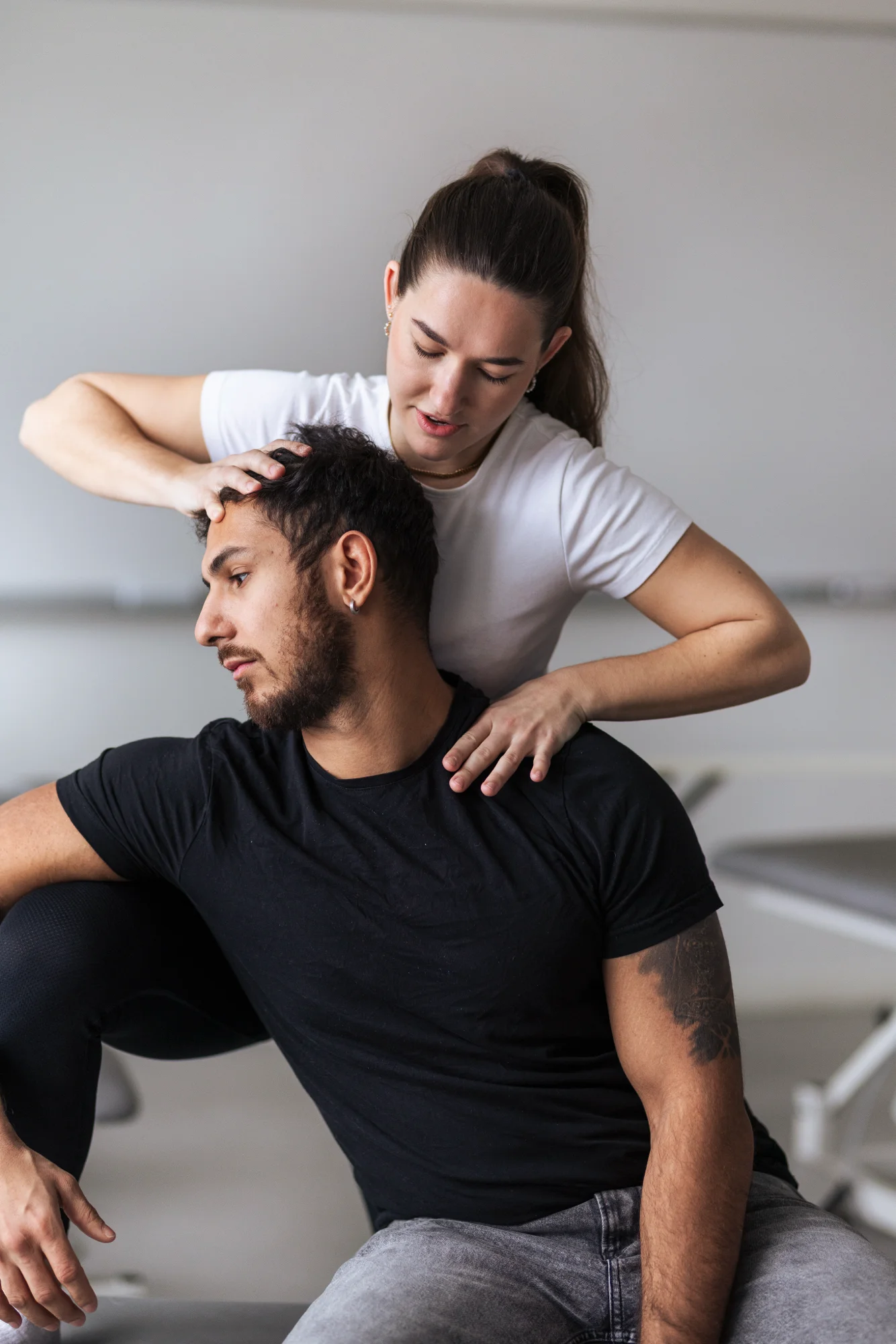
Half of the studies in the programme in naprapathy are devoted to courses such as anatomy, physiology, neurology, orthopedics, and sports medicine. The other half includes specialization in the main subject of naprapathy, where you learn to examine and diagnose muscle and joint issues, as well as master manual treatment techniques: trigger point therapy, stretching, classic massage, mobilization, and manipulation.
To ensure that you as a naprapath can prevent issues and work with rehabilitation, the teaching of manual treatment techniques is supplemented with subjects such as exercise science and ergonomics. The combination of medical knowledge and specialization in naprapathy allows you as a naprapath to take responsibility for making diagnoses and deciding when to treat patients yourself or when to refer them to a doctor or other healthcare provider.
During the second semester of the program, you begin to practice your skills at one of the college's clinics. There, as a student, you will receive your own patients who have sought treatment at the college, under the supervision of licensed naprapaths. Clinical naprapathy, or work-integrated learning (VFU), as it is also called, forms the link between theoretical and practical teaching.
Scientific development is a subject area that continues throughout the entire education, and during the fourth year, you use these skills when writing your degree project in an area you have chosen to specialize in. Once you have passed all courses and completed your final examination with a passing grade, you will receive your naprapathy degree and be well-prepared to begin your internship and start your professional career as a licensed/authorized naprapath.
NIMM’s pedagogical profile is characterized by a strong connection between theoretical, practical, and clinical teaching. The theoretical and practical components are located at NIMM’s premises in Kräftriket, and the work-integrated learning is carried out at NIMM’s clinic in Vasastan.
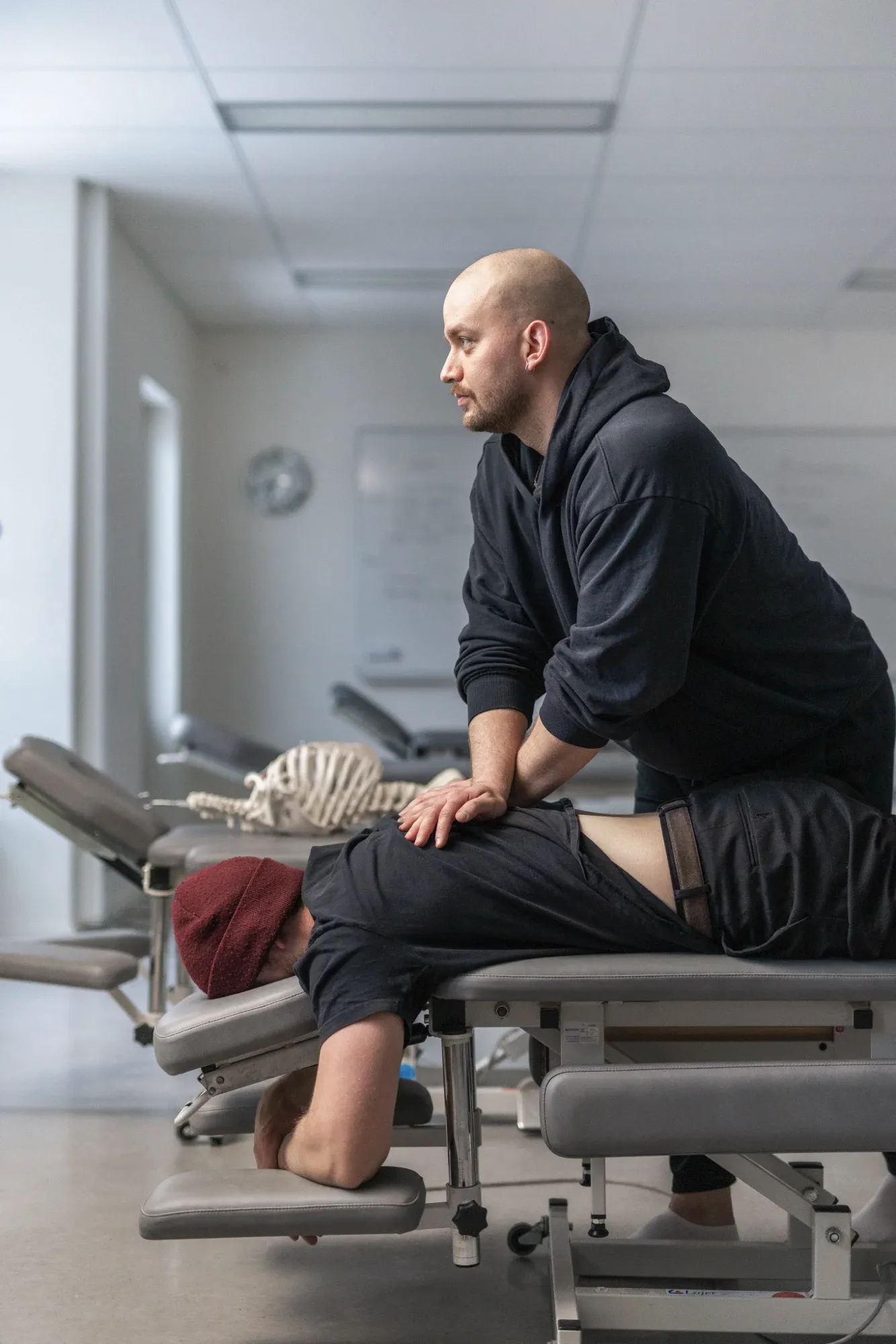
The practical teaching aims to familiarize you with the treatment methods used in the naprapathic profession before you meet patients in the work-integrated training. At NIMM’s clinic, you as a student receive and treat patients under the supervision of licensed naprapaths with extensive clinical experience.
The concept of research integration refers to the proportion of teaching conducted by teachers with research qualifications, how the connection between research and education is secured, and how students' ability for critical and independent thinking is stimulated. A prerequisite for good research integration is the presence of teachers and examiners with research qualifications, as well as research activity conducted in connection with the education.
Many of the college's teachers hold doctoral degrees, which ensures that students' knowledge formation rests on a scientific foundation and provides insight into the development and research frontier of each respective field. In the courses Theory of Science 1-3 and the Degree Project, which are central to the scientific method and theory education for students in the main subject of naprapathy, all lecturers and responsible teachers at NIMM are PhD holders and/or active researchers at Karolinska Institutet, Sophiahemmet University, or Stockholm University.
NIMM’s clinic provides unique opportunities to conduct clinical research in which both students and teachers can participate. In 2010, an extensive clinical study, the "Manual Intervention Trial," was launched in collaboration with Karolinska Institutet with the aim of developing the main subject of naprapathy by comparing the effects of different combinations of treatment methods. In 2014, another major study began at NIMM’s clinic in collaboration with Karolinska Institutet. The study is called the "Stockholm Neck Trial" and investigates the effects of massage and exercise on chronic neck pain. In 2018, work began on the "Progression Study" together with Sophiahemmet University. The purpose of the study is to examine which factors are significant in predicting different pain trajectories for back and neck issues.
The research projects are important both for promoting a critical approach and for providing future naprapaths with the prerequisites to follow knowledge development and personally contribute to the advancement of the profession throughout their working lives. The research projects also provide material for scientific articles and the degree projects that students write at the end of their education.
NIMM has held collaboration agreements with the Institute of Environmental Medicine at Karolinska Institutet since 2009 and with Sophiahemmet University since 2019. Within the framework of these agreements, continuous investments are made in research and development. For example, extensive, high-quality international scientific studies have been conducted at NIMM since the spring of 2010.
The results of these studies, which are regularly published in international scientific journals, provide important answers to questions such as the optimal care for patients seeking naprapathic treatment, and how symptoms in back and neck patients vary over time—providing in-depth knowledge regarding the prognosis for back and neck pain. Together with Karolinska Institutet and Sophiahemmet, we also conduct several scientific projects within naprapathy and sports medicine.

Admissions to the Naprapathic Program are rolling and will close once all spots for the autumn 2026 semester are filled. Secure your spot—apply now!