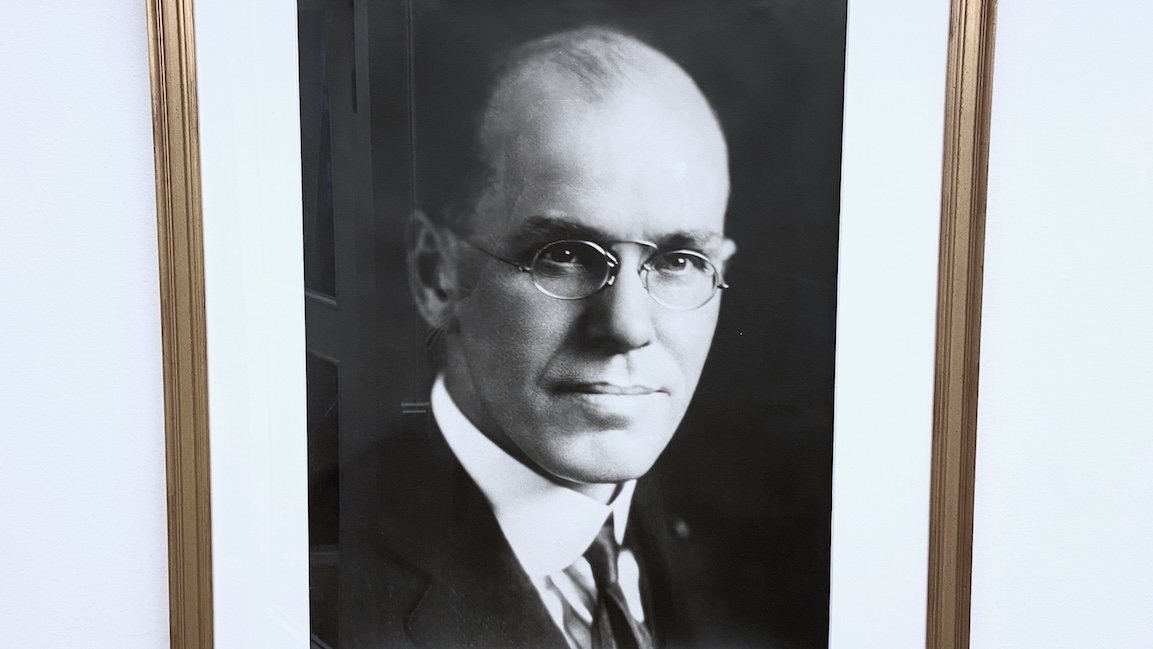
Oakley Smith was born on January 19, 1880, in West Branch, Iowa. His mother, Ann Beeson Smith, and his father, Robert Barkington Smith, ran a large farm on the outskirts of the town. The family also included Oakley's two older brothers, Ralph and Horton. At the age of four, Oakley contracted scarlet fever, which would shape the rest of his upbringing, but also lead Smith to eventually become interested in medicine. These medical studies would play an important role in the creation of an entirely new profession: naprapathy.
"..." During treatment with Dr. D. D. Palmer, the founder of chiropractic, Oakley became interested in the treatment methods, which led him to choose to train as a chiropractor himself. This training lasted for 6 days and consisted of observing Palmer as he treated patients. After this, Oakley received a diploma in chiropractic.
Oakley Smith was disappointed that he did not fully recover from the treatment and, according to himself, woke up on February 1, 1899, with the thought: "If no one else can figure out what is wrong with me and cure me, I will have to do it myself."
In the autumn of 1899, Smith was admitted to and began studying at The Medical School, University of Iowa. He was admitted as a special student, as he only studied anatomy, physiology, and dissection. He was also present and took notes in histology and pathology, and participated in 300 surgical operations. Here, Smith realized the importance of systematic study and careful documentation, something that would later influence how he planned and conducted education himself.
Smith's older brother, Horton, also studied at the university, and during this period, Smith instructed his brother on how to use manipulation techniques to achieve various effects on his back and his health condition. Smith received treatments from his brother every day for a three-month period, and the results were very good. Smith thus succeeded, with the help of his brother, in curing himself. "..."
When Smith finished his studies in 1901, he began experimenting with different techniques but also developed explanatory models for both the underlying causes of pain and illness and the treatment effects his techniques provided. He treated his family, his friends, and his neighbors, and in doing so, created a broad experience.
At this time, Smith had two clinics, one in Iowa City and one in nearby Cedar Rapids. He was primarily interested in learning more and developing techniques, which is why he did not yet charge for his treatments.
Several of Smith's patients became interested in the techniques he had developed, which led him to begin organizing instruction for groups of students. Gradually, his way of working without payment became unsustainable, and he closed the two clinics he had to open a new one in Chicago. There, Smith's treatment methods were a success, and many patients sought out his clinics. After a time, Smith chose to resume his search for knowledge, and this time he did so by traveling to Europe, where he visited England, Holland, and Sweden, among other places, before staying and spending the most time in Czech Bohemia. He stayed there in the summer of 1902, and when he returned home, he brought with him both inspiration and what was called there "the Bohemian Thrust" or, as it was also referred to, the "napravit thrust"—a treatment technique where one used quick hand movements—thrusts—to restore function and mobility in the spinal joints. The Czech word "napravit" stands for "to correct." This trip likely led to Smith later choosing to call the profession he created "Naprapathy." "Napravit" became the first part of the word, and the Greek "pathos," meaning suffering or feeling, became the second part. Naprapathy thus came to stand for "correcting suffering."
After returning home, Smith began collaborating with Dr. Solon Langworthy, a chiropractor, inventor, and publisher, and Dr. Minora Paxon, the first woman in Illinois to be licensed as a chiropractor. In 1903, Langworthy started the "American School of Chiropractic and Nature Cure" in Cedar Rapids, a school that directly competed with Palmer's school of chiropractic. Smith and Paxon joined Langworthy, and the three of them developed the education at the school together. The school was the first to combine manipulative techniques with other techniques, such as massage. This would later also to some extent characterize Smith's development of naprapathy. "..."
Oakley Smith was disappointed that he did not fully recover from the treatment and, according to himself, woke up on February 1, 1899, with the thought: "If no one else can figure out what is wrong with me and cure me, I will have to do it myself."
In the autumn of 1899, Smith was admitted to and began studying at The Medical School, University of Iowa. He was admitted as a special student, as he only studied anatomy, physiology, and dissection. He was also present and took notes in histology and pathology, and participated in 300 surgical operations. Here, Smith realized the importance of systematic study and careful documentation, something that would later influence how he planned and conducted education himself.
Smith's older brother, Horton, also studied at the university, and during this period, Smith instructed his brother on how to use manipulation techniques to achieve various effects on his back and his health condition. Smith received treatments from his brother every day for a three-month period, and the results were very good. Smith thus succeeded, with the help of his brother, in curing himself. "..."
When Smith finished his studies in 1901, he began experimenting with different techniques but also developed explanatory models for both the underlying causes of pain and illness and the treatment effects his techniques provided. He treated his family, his friends, and his neighbors, and in doing so, created a broad experience.
At this time, Smith had two clinics, one in Iowa City and one in nearby Cedar Rapids. He was primarily interested in learning more and developing techniques, which is why he did not yet charge for his treatments.
Throughout his career to date, Dr. Smith had been interested in seeking the cause of his patients' ailments. Smith was originally a chiropractor, and he strove to prove the validity of the subluxation theory by inventing several instruments to demonstrate how vertebrae could partially slip out of place. During these studies, Smith became critical of Palmer's subluxation theory, as his research tended to show that vertebrae could not slip out of place in the way previously described. Smith then began searching for other causes of ailments and began research with that focus in earnest in 1905.
According to Smith himself, he made the discovery that led to the creation of the naprapathy profession on November 16, 1905, at 11:45 PM. While dissecting a specimen, Smith had taken a tissue sample from the spine and the structures surrounding the spinal joints. The tissue sample also contained the ligaments surrounding the joints, and this was exactly what Smith was interested in. In his microscope, he saw scar tissue in the ligaments that had grown together with and affected nearby nerves, arteries, and veins. Smith immediately realized that his discovery was groundbreaking; this could be the answer to what he had been looking for—a cause for the pain for which patients sought his help. By his own account, he was so happy that he "danced a jig" by himself. The finding he made later led to the theories that formed the basis of naprapathy: the ligatite theories. Over the years leading up to 1907, Smith wrote down his research findings but did not publish them until 1919 in The Connective Tissue Monograph: Naprapathic Connectivology vol I.
During the years 1904-1905, Smith wrote the book that would become the first true textbook in manual medicine, Modernized Chiropractic.
The book was published in 1905 and was later supplemented with a 16-page addendum describing the development of naprapathy, "Naprapathy Genetics: Being a study of the origin and development of Naprapathy."
In the book, Smith presented not only his theories on ligatites, from which he built the core idea that would characterize naprapathy, but also how to organize one's clinic and one's way of examining and treating patients to provide good care. Modernized Chiropractic was a groundbreaking book in many ways. Among many other things, it was actually the first real documentation in chiropractic and manual medicine. However, it was not really to be considered chiropractic, but "Modernized Chiropractic," and according to Smith, it should be seen as something new—what he was actually describing was naprapathy, even if that name had not yet been adopted. The author does not mention Palmer or the techniques he taught, but instead attributes these techniques to "napravit" and the Bohemian immigrants. The book includes, among other things, a picture of an immigrant from Bohemia treating a countryman with the very techniques that Palmer claimed to be the first to use.
To provide a historical perspective on this, this region of the USA, where both Smith and Palmer were active, was an area with significant immigration from Bohemia, which makes it more than likely that both Smith and Palmer were actually inspired by these people. The authors of Modernized Chiropractic claim that napravit is one of the cornerstones of chiropractic as well.
Modernized Chiropractic also provided the first reference to what is today called motion palpation—examining the body and joints in dynamic motion instead of at rest. Smith viewed the joints in the back as having a normal range of motion and a normal axis of rotation. These references to spinal dynamics form the basis for much of today's manual medicine. The roots of the theories regarding the importance of dynamic motion thus come from Smith, which several prominent researchers have later confirmed.
Practicing manual medicine during this period was not always easy. The traditional medical establishment was critical of all complementary medicine, and representatives of the various branches, such as manual medicine, had to fight hard to establish their disciplines.
The attitude held by representatives of traditional medicine led to chiropractors being accused of conducting illegal activities—it was claimed that they were practicing medicine without a license. The chiropractors themselves argued that their practice was something entirely different, namely chiropractic, and that the differences between what they did and traditional medicine were significant. The representatives of school medicine took their accusation against the chiropractors to court. To demonstrate the differences between chiropractic and traditional medicine, the chiropractors' lawyers used Modernized Chiropractic in the trial, even though the chiropractors initially did not in any way acknowledge either Dr. Smith or his textbook. The representatives of chiropractic won the trial and were able to continue practicing as before.
Smith's edition of Modernized Chiropractic prompted Palmer to release a textbook a few weeks after Modernized Chiropractic was published. The book was titled The Chiropractor.
Smith's book, Modernized Chiropractic, was published in a new edition in 2007 under the name The History of Naprapathic Medicine, initiated by the Naprapathic College in Stockholm and in collaboration with the National College of Naprapathic Medicine, Chicago.
Even during the short time he trained as a chiropractor under Palmer at the end of 1899, Smith had ideas about how education could be conducted differently, based on the new discoveries he had made. Consequently, in 1907, Smith started the Chicago College of Naprapathy on South Marshfield Avenue in Chicago.
Admissions to the program took place twice a year, and women and men were accepted on equal terms, which was very unusual in 1907.
The education was two years long and, in addition to naprapathy, included the basic medical subjects found in today's naprapathic training. Anatomy was considered especially important, and over 1,000 hours of instruction were provided in this area during those two years. The corresponding time for medical students at that time was 700 hours.
Smith was very meticulous about ensuring the education was well-organized and that each area was supported by appropriate course literature. His own book, Modernized Chiropractic, naturally held a prominent place in the theoretical and practical instruction of naprapathy.
Students completed their clinical practice at Cook County Hospital in Chicago, which was located just five minutes from the school. Here, they were examined and conducted practice alongside physicians. This indicates that they were already accepted for their knowledge outside their own circle.
Smith continued his research while teaching at the school. He started several smaller schools with the aim of spreading naprapathy, as well as increasing knowledge of and confidence in naprapathy within the existing healthcare system. The Second World War brought major changes to society, and to Smith and his students as well. The war necessitated moving classes to the evening.
In 1917, Smith published another book, Naprapathic Chartology, in which he described how naprapaths examine patients, record their findings, diagnose ailments, and treat them. Chartology, the system for recording examination findings and treatments, was unique to naprapathy.
In 1949, internal conflicts arose between individual naprapaths and the established school. Harald Swanstrom, a naprapath and chairman of the well-established professional organization, the American Naprapathy Association, wanted the education to be longer and more comprehensive. Developing the program and adding more content would strengthen the credibility and competence of naprapaths, which in turn would create the conditions for them to obtain their own licensure.
Smith did not believe licensure was necessary, as he felt that naprapaths were not practicing medicine in the same sense as, for example, physicians. In a historical light, this may seem strange, as Smith himself was a driving force in the early 1900s for obtaining licensure for chiropractors. The result of the conflicts and differing opinions was the creation of a competing school, the National College of Naprapathy (NCN). The two schools existed side by side during the 50s and 60s. When Smith died in 1967 at the age of 87, his school lost many students, leading the two schools to merge. Together, they formed the Chicago National College of Naprapathy, which still trains naprapaths today, though under the name National College of Naprapathic Medicine.
In 1988, naprapathy was on the verge of obtaining its own licensure in the United States. Everything was ready, and the authorities had given their approval for the licensure of naprapaths. However, lobbyists from the medical profession managed to sway the majority of votes, and the proposal was defeated. Furthermore, it was decided that only chiropractors, osteopaths, and physicians were permitted to practice naprapathy. The school in Chicago was temporarily closed due to this decision. Naprapaths fought for the right to practice their profession. After several legal proceedings, the naprapaths finally won the battle, and in 1992, the school reopened and naprapaths were granted their own licensure in Illinois.
Admissions to the program took place twice a year, and women and men were accepted on equal terms, which was very unusual in 1907.
The education was two years long and, in addition to naprapathy, included the basic medical subjects found in today's naprapathic training. Anatomy was considered especially important, and over 1,000 hours of instruction were provided in this area during those two years. The corresponding time for medical students at that time was 700 hours.
Smith was very meticulous about ensuring the education was well-organized and that each area was supported by appropriate course literature. His own book, Modernized Chiropractic, naturally held a prominent place in the theoretical and practical instruction of naprapathy.
Students completed their clinical practice at Cook County Hospital in Chicago, which was located just five minutes from the school. Here, they were examined and conducted practice alongside physicians. This indicates that they were already accepted for their knowledge outside their own circle.