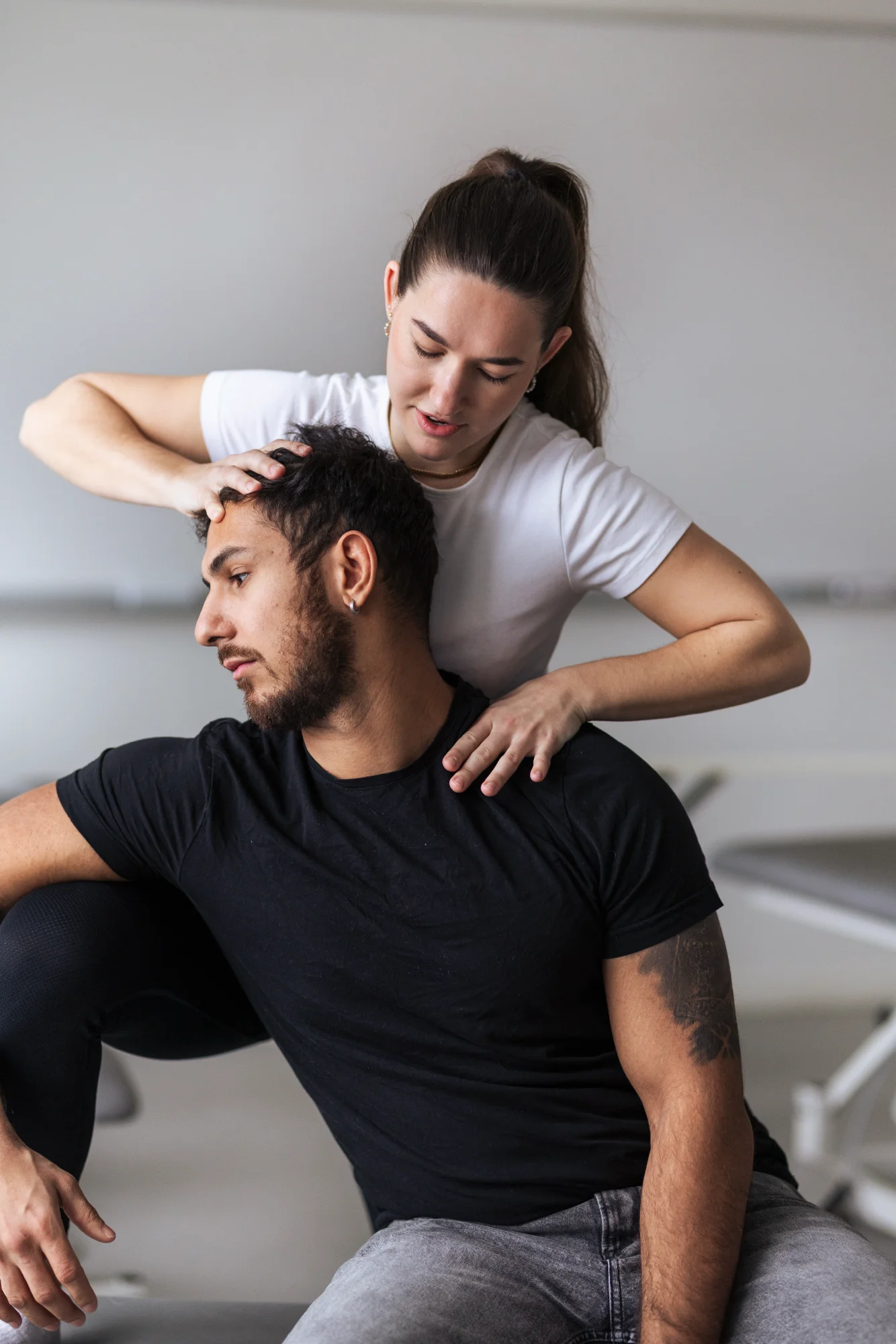
There are good reasons to consider both professions. Naprapaths and physiotherapists partly see the same patients and share important areas of knowledge, not least in movement, function, rehabilitation and pain. But the programmes do not lead to the same profession, and they do not have the same emphasis.
The most important question is therefore not which programme is ‘best’, but what you actually want to become good at and what you want your future working day to look like.
Programme in Sweden
Four years full-time at NIMM, with manual medicine as the main subject throughout
Emphasis
Examination, diagnosis, manual treatment and rehabilitation of neuromusculoskeletal conditions
Licensure in Sweden
After the naprapathy degree and one year of practical service
In Norway
A licensed profession since 2022. Helsedirektoratet assesses applications for licensure
Programme in Sweden
Three years full-time, 180 higher education credits
Emphasis
Movement, function and rehabilitation for many patient groups and conditions
Licensure in Sweden
After the physiotherapy degree
In Norway
Three-year bachelor’s degree and one year of internship (turnus) before licensure
A patient with back pain can see either a naprapath or a physiotherapist. The same applies to a runner with knee problems, a person with neck pain after long hours at the computer, or an athlete who needs rehabilitation after an injury. That is an important reason why the professions are sometimes seen as more alike than they really are.
The overlap is real. Both professions examine and assess patients and work with rehabilitation, physical activity and advice. Both need to understand anatomy, physiology, pain, pathology and how the body responds to load. But from there, the programmes start to pull in different directions.
Physiotherapy is a broad healthcare profession with human movement and function at its core. Naprapathy is an educational path within manual medicine with a more concentrated focus on neuromusculoskeletal conditions – problems that mainly affect the muscles, joints, musculoskeletal system and related nerve function. The difference is therefore less about whether both professions can see a patient with back pain, and more about what competence the programme systematically builds over several years of study.
The breadth of physiotherapy
Where the professions meet
The core of naprapathy
The figure shows where each programme places its emphasis, not the limits of what an individual practitioner works with.
The great strength of the physiotherapy profession is its breadth. A physiotherapist can work in primary care, hospital care, neurological rehabilitation, geriatrics, psychiatry, orthopaedics, sports medicine and rehabilitation after surgery or serious illness. The profession covers people of all ages and far more conditions than problems with muscles and joints.
That breadth is already reflected in the education. Karolinska Institutet, for example, describes the human being in movement as the starting point of physiotherapy and trains its students in the interplay between movement, function and health. The programme also covers medical subjects, psychology, education and behavioural medicine, and students are trained in communication and clinical reasoning. Swedish physiotherapy programmes normally comprise 180 higher education credits, equivalent to three years of full-time study.
For anyone drawn to rehabilitation in the broad sense, this is a clear advantage. Perhaps you want to work with stroke patients in one part of your career, in orthopaedics in another, and later with older people, athletes or people with long-term illnesses. Physiotherapy then gives you a broad professional platform.
If physiotherapy’s strength is its breadth, naprapathy’s strength is its clear focus. The Programme in Naprapathy at NIMM comprises four years of full-time study and is built around manual medicine, with theoretical, practical and clinical teaching running in parallel throughout. Students study subjects such as anatomy, physiology, neurology, orthopaedics, pathology, pain, diagnostics, rehabilitation and exercise science, while gradually developing their practical and clinical skills.
This does not mean the programme is only about hands-on treatment. A modern naprapath must be able to take a structured case history, examine the patient, weigh up possible causes of the symptoms, recognise situations that call for other medical investigation, and draw up a treatment and rehabilitation plan together with the patient. Manual treatment methods are combined with, for example, exercise, rehabilitation, advice and support for self-care.
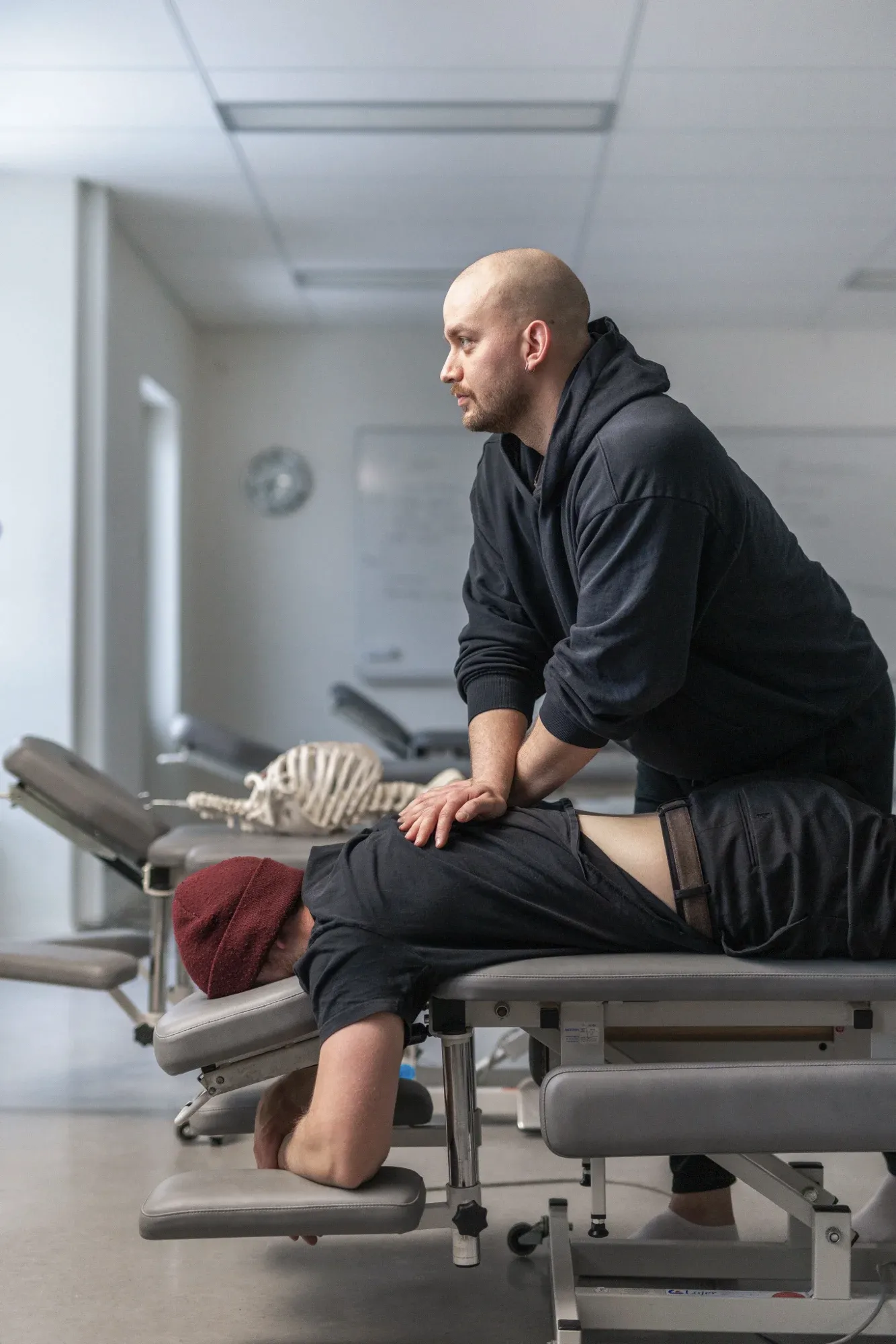
But there is no getting around the fundamental difference: manual medicine is not an add-on to the naprapathy programme but the professional field itself. At NIMM, clinical teaching and patient contact also begin as early as the second semester and continue throughout the programme.
If you know from the outset that you want to work very hands-on with examining and treating musculoskeletal conditions, this is a relevant difference. The naprapathy programme is simply designed to provide far more coherent training in exactly this area.
Yes, and it is important to say so clearly. Manual examination and treatment techniques are part of physiotherapy, and there are physiotherapists with very high levels of expertise in musculoskeletal care. Physiotherapists can also undertake further training in, for example, orthopaedic manual therapy (OMT) and so deepen their expertise in manual and musculoskeletal physiotherapy.
Describing physiotherapy as a profession without manual treatment would therefore be wrong. The real difference lies rather in how central manual medicine is in the basic programme.
For a physiotherapist, musculoskeletal rehabilitation is one of several possible professional fields. For a naprapath, examining, diagnosing, treating and rehabilitating neuromusculoskeletal conditions is the core of the programme and of the future professional role.
That is also why it is misleading to present naprapath and physiotherapist as two different titles for roughly the same job. There is an overlap, but the programmes set different priorities and prepare students for partly different professional roles.
Another simplification worth avoiding is the idea that naprapaths do treatment while physiotherapists do exercise. Modern musculoskeletal care is not that simple.
A naprapath needs to understand load, physical activity and rehabilitation, and be able to give patients the tools to influence their own function and symptoms. In the same way, a physiotherapist can use manual methods where appropriate within the scope of their competence.
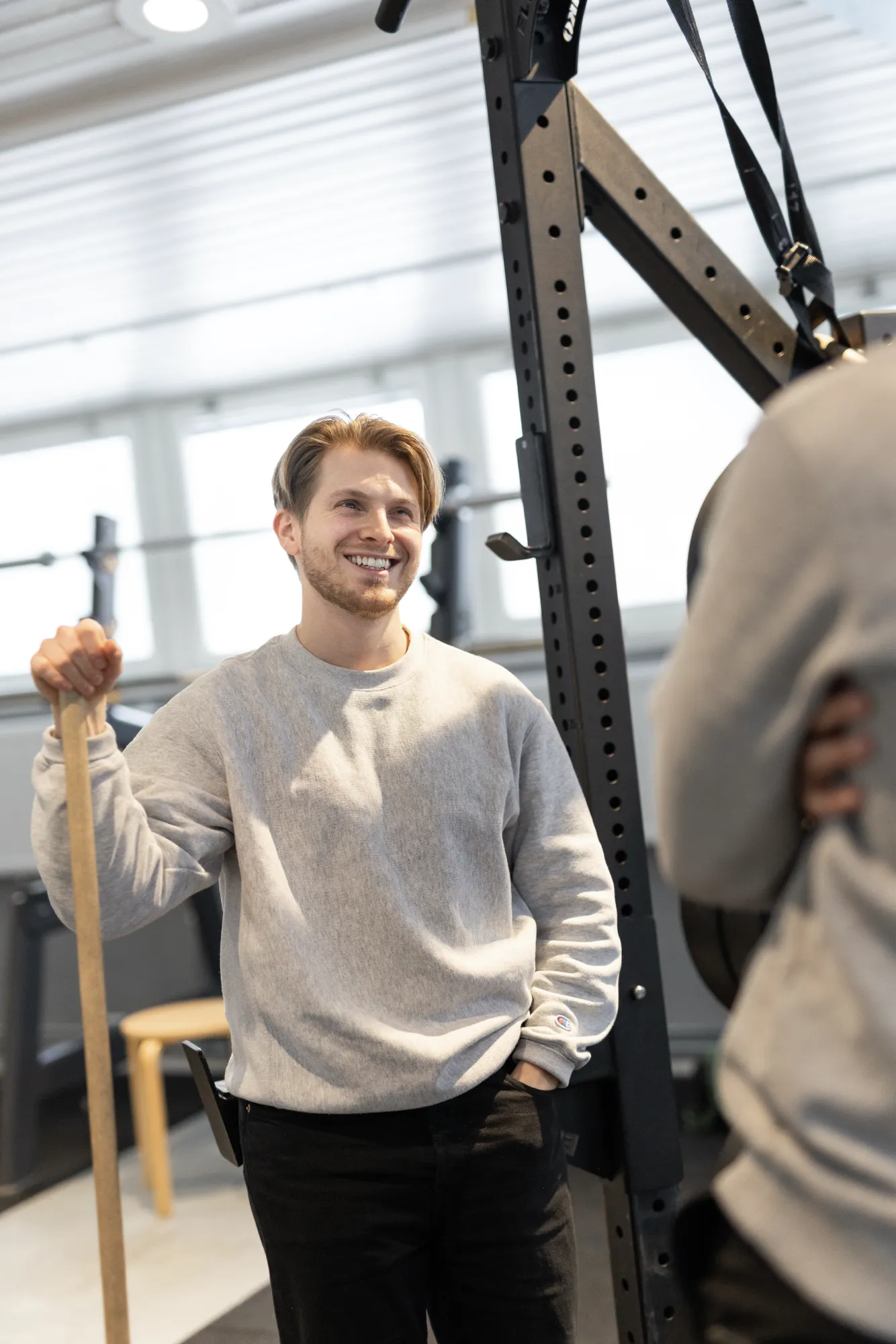
The difference is therefore not a choice between hands and exercise programmes. It is about the programmes’ emphasis and professional identity. For the naprapath, practical manual examination and treatment are a central part of their competence, alongside diagnostics, rehabilitation and exercise. Physiotherapy instead takes movement and function as its starting point and covers a far broader range of illnesses, disabilities and rehabilitation situations.
For a prospective student, that distinction is far more useful than trying to work out which profession uses the most of any single treatment method.
Choosing a clear focus on muscles, joints and the musculoskeletal system does not mean choosing a small field. On the contrary, musculoskeletal conditions are among the world’s biggest health problems. WHO estimates that around 1.71 billion people live with musculoskeletal conditions and describes them as the leading contributor to disability worldwide. Low back pain is the single leading cause of disability in 160 countries.
1.71 billion
people worldwide live with musculoskeletal conditions, making them the leading contributor to disability globally.
Source: WHO
Behind the figures are, of course, individuals: the person who can no longer run, the person who struggles to work because of back pain, the athlete who wants to return after an injury, or the patient whose neck problems affect both work and sleep. It is in meeting these people that both physiotherapists and naprapaths can make a difference.
If you are particularly fascinated by how muscles, joints, the nervous system, load, pain and function interact, there are good reasons to choose a programme in which this field is given plenty of room.
In Sweden, naprapath and physiotherapist are both licensed healthcare professions. The paths to licensure, however, differ.
The path to licensure
Sweden
Naprapath
Physiotherapist
Norway
Naprapath
Physiotherapist
The height of each block reflects its duration.
A Swedish physiotherapy programme normally comprises three years of full-time study. After completing the physiotherapy degree, the graduate can apply for licensure from the Swedish National Board of Health and Welfare (Socialstyrelsen). The Programme in Naprapathy at NIMM comprises four years of full-time study. After the naprapathy degree, Socialstyrelsen also requires supervised practical service equivalent to nine months full-time with a licensed naprapath and three months in public healthcare before a Swedish licence can be issued.
This means that the naprapathy programme at NIMM is itself one year longer than the Swedish physiotherapy programme. But the choice of programme should not be decided by counting years of study. What matters is what the years are used for. The extra time in naprapathy is part of a coherent four-year professional programme in manual medicine, with early and recurring practical and clinical training.
For Norwegian students, the path to licensure – autorisasjon in Norwegian – looks different. In Norway, physiotherapy consists of a three-year bachelor’s degree followed by a compulsory one-year internship (turnus) before licensure. Naprapath has been a licensed profession in Norway since 2022, and the Norwegian Directorate of Health (Helsedirektoratet) has specific rules for, among others, naprapaths trained in Sweden who need to complete supervised practice. The requirements should always be checked before choosing a programme, as the rules on licensure may change.
Comparing syllabuses matters, but there is a simpler question that often makes the choice clearer: how do you want to work once you have qualified?
Physiotherapy can be a very good choice if you want to work broadly with movement, function and rehabilitation, and several areas of healthcare appeal to you. Perhaps you do not yet know whether you want to work with musculoskeletal patients, neurology, older people, rehabilitation after surgery or something else entirely.
Then the broad basic programme is a strength. Physiotherapy offers many possible paths onwards and the chance to specialise later in, for example, sports medicine or musculoskeletal physiotherapy.
Naprapathy may be a more natural choice if it is above all muscles, joints, pain, sports injuries, clinical examination and manual treatment that make you want to work in healthcare. You then get a four-year programme in which these areas are not a possible future specialisation but a central part of the programme from the very start.
It also suits many people who want a very practical profession and enjoy the combination of medical knowledge, problem-solving, manual skills, rehabilitation and close patient contact.
The physiotherapy programme is a very good choice for anyone who wants a broad professional field in movement, function and rehabilitation. The naprapathy programme is a very good choice for anyone who wants to specialise in manual medicine and work in a focused way with neuromusculoskeletal conditions.
If you are choosing between naprapath and physiotherapist, do not just ask yourself which programme sounds most interesting. Picture your future working day instead. Which patients do you want to meet? Which problems do you want to become really good at assessing? How much do you want to work hands-on? Do you want a broad rehabilitation profession or a more focused programme in manual medicine?
Once you can answer those questions, choosing the right programme becomes much easier.
At the School of Naprapathy at NIMM in Stockholm, the Programme in Naprapathy is four years full-time, is under government supervision by Universitetskanslersämbetet and is eligible for student finance. Swedish students apply for student finance from CSN and Norwegian students from Lånekassen. Clinical patient contact starts as early as the second semester.